

For a long time, Meta advertising followed a predictable formula.
You defined interests, built lookalikes, split audiences into neat buckets, tested headlines and creatives in isolation, and scaled what worked. That system rewarded precision and control.
That system no longer exists.
Meta hasn’t just updated its algorithm — it has fundamentally changed how it understands audiences, creatives, and intent. If you’re still running ads the way you did a year or two ago, you’re not just leaving performance on the table — you’re actively working against the platform.
This is what’s changed, and how smart advertisers are adapting in 2026.
The Shift: From Control to Collaboration
The biggest mistake advertisers make today is assuming they still “control” Meta ads.
You don’t.
Modern Meta campaigns perform best when they are designed to collaborate with the algorithm, not constrain it. The platform no longer relies on the manual inputs you obsess over — interests, micro-audiences, and granular segmentation.
Instead, it learns from signals.
And the strongest signal you provide isn’t targeting — it’s creative.
Creative Is the New Targeting
Meta now uses creative performance to determine who your ads should be shown to.
This means:
- The algorithm doesn’t need you to define the audience
- It learns the audience based on who engages, watches, clicks, and converts
- Your creative teaches Meta what kind of person resonates with your message
In other words, creative has replaced targeting.
If your ads are generic, vague, or overly polished with no emotional clarity, Meta has nothing meaningful to learn from — and performance stalls.
Why Traditional Testing No Longer Works
Old-school testing focused on surface-level changes:
- A new headline
- A different CTA
- A slight visual tweak
That kind of testing doesn’t help the algorithm anymore.
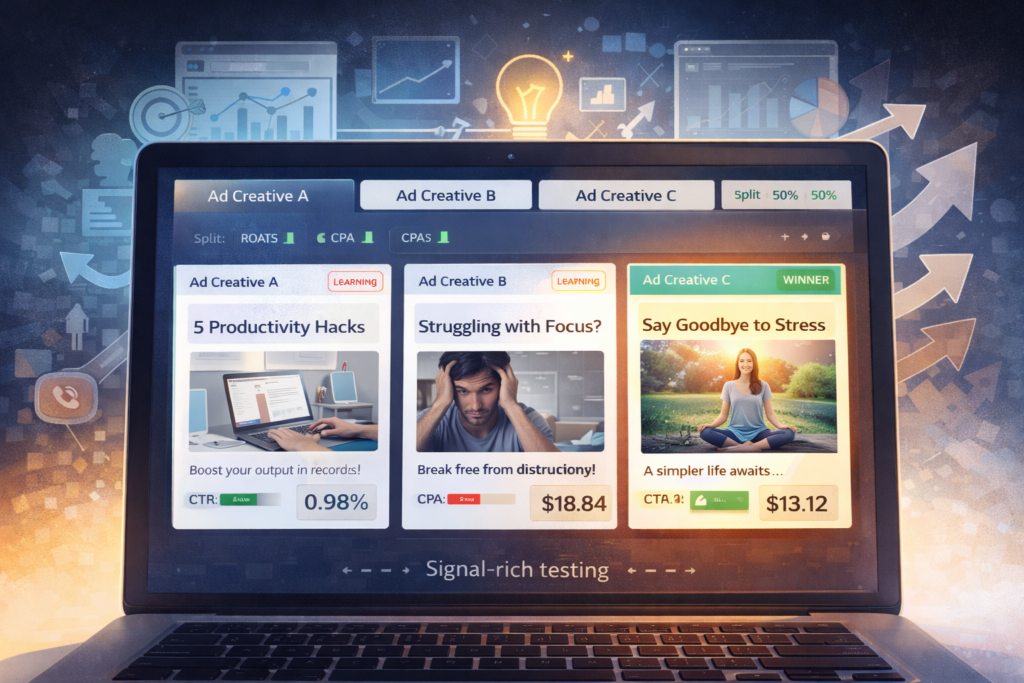
Modern testing needs to be intentional and signal-rich. Each variation should communicate a distinct angle, belief, or problem — not just a cosmetic difference.
Good testing today answers questions like:
- Does this message resonate with awareness-level users?
- Does this framing convert problem-aware users faster?
- Does this narrative hold attention longer?
Testing is no longer about finding “the winner.”
It’s about helping the system learn faster and predict better outcomes.
Simplicity Beats Complexity
Another major shift: simpler account structures outperform complex ones.
Many advertisers still believe that more ad sets, more audiences, and more segmentation equals more control. In reality, it creates noise.
Meta performs best when:
- Campaigns are consolidated
- Budgets are concentrated
- Creatives do the heavy lifting
When you over-segment, you starve the algorithm of data. When you simplify, you accelerate learning.
What Winning Meta Ads Look Like in 2026
Top-performing brands are aligning around a few core principles:
1.
Creative-First Strategy
Creatives are not decorative — they are strategic assets designed to generate clear behavioral signals.
2.
Narrative Over Polish
Relatable, story-driven content consistently outperforms overproduced ads. Authenticity beats perfection.
3.
Algorithm-Friendly Testing
Fewer, better variations that communicate distinct messages — not endless minor tweaks.
4.
Audience Expansion by Design
Instead of locking ads into narrow audiences, strong creatives allow Meta to find high-intent users at scale.
Why Many Brands Are Struggling Right Now
If your Meta performance feels unpredictable, inconsistent, or fragile, it’s usually because:
- You’re relying on outdated targeting logic
- Your creatives don’t communicate clear intent
- Your structure is optimized for control, not learning
The algorithm isn’t broken.
The strategy is outdated.
The Way Forward
Meta advertising in 2026 rewards a different mindset.
Less obsession with hacks.
Less micromanagement.
More clarity, better storytelling, and systems that respect how the platform actually works today.
Brands that adapt are scaling efficiently.
Brands that don’t are watching costs rise and results flatten.
The gap isn’t talent.
It’s understanding.
If you’re willing to evolve how you think about Meta ads, the opportunity has never been bigger.