
Meta’s advertising platform has evolved rapidly over the last few years, with automation and artificial intelligence now at the core of how campaigns are delivered and optimised. One of the most important systems driving this shift is Andromeda, Meta’s large-scale AI engine responsible for ad ranking and delivery across Facebook and Instagram.
Understanding how Andromeda works—and how to design campaigns that align with it—has become essential for brands looking to achieve sustainable performance from Meta ads.
What Is Andromeda in Meta Advertising?
Andromeda is Meta’s AI-driven ad ranking and delivery system that determines:
- Which ad is shown
- To which user
- At what moment
- Across which placement
Instead of relying primarily on manual targeting or rigid optimisation rules, Andromeda evaluates billions of real-time signals to predict the likelihood of a specific ad achieving a desired outcome, such as a lead, purchase, or engagement.
This system powers delivery across Facebook, Instagram, Reels, Stories, and other placements, enabling cross-platform optimisation at scale.
Why Andromeda Matters in a Post-Privacy Advertising Landscape
With reduced access to user-level data due to privacy updates and platform changes, Meta has shifted toward probabilistic and modelled decision-making. Andromeda is built specifically for this reality.
By analysing large-scale behavioural patterns rather than relying on perfect tracking, it allows campaigns to continue optimising even when data is incomplete or delayed.
For advertisers, this reinforces an important shift: performance is no longer driven by micro-targeting, but by how well the system is trained through inputs.
How Andromeda Changes Campaign Structure and Optimisation
One of the most noticeable impacts of Andromeda is how it rewards simpler, less fragmented campaign structures.
Traditional approaches often relied on:
- Highly segmented audiences
- Multiple overlapping ad sets
- Heavy manual intervention
In contrast, Andromeda performs best when it has sufficient data volume and freedom to learn. Fewer campaigns and clearer conversion signals allow the system to allocate spend more efficiently.
Creative and Copy: The Primary Performance Lever in Andromeda-Led Campaigns
With the latest updates to Meta’s ad delivery system, creative and ad copy now play a disproportionately large role in performance.
As targeting and delivery become more automated, Andromeda increasingly differentiates ads based on how users respond to the message, visual, and clarity of the offer.
This makes it critical for creatives and copy to be:
- Clear and succinct
- Immediately understandable within the first few seconds
- Aligned with a specific user pain point or intent
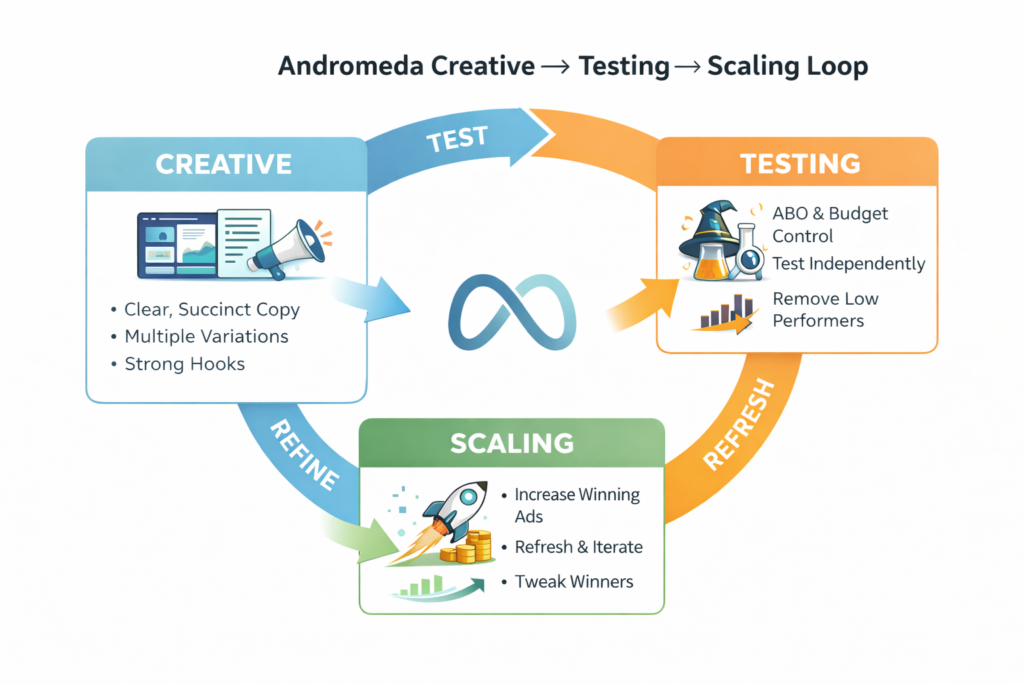
Just as important, creatives cannot remain static. High-performing accounts follow a structured creative refresh cycle, where:
- Winning creatives are identified early
- Variations of those winning creatives are refreshed and reintroduced
- Messaging is iterated without changing the core hook
Tracking which creatives are performing—and why—becomes essential. The goal is not to constantly reinvent ideas, but to systematically evolve what already works.
Managing Creative Fatigue and Underperforming Ads
Not every creative will perform well, and in Andromeda-led campaigns, some ads may get overshadowed by stronger performers before they have enough opportunity to be fairly evaluated.
A practical approach is to:
- Move under-delivering creatives into a separate ad set
- Allocate them dedicated budget and time to test independently
- Assess performance without competition from top-performing ads
If these creatives still fail to generate meaningful results, they can be confidently discontinued. This ensures that decisions are based on data, not premature judgement.
This disciplined approach prevents potentially strong ideas from being buried too early, while also keeping the overall system efficient.
Why ABO Often Works Better Than CBO for Creative Testing
While Meta promotes Campaign Budget Optimisation (CBO), Ad Set Budget Optimisation (ABO) often provides better control during the creative testing phase.
ABO allows advertisers to:
- Allocate budget evenly across ad sets
- Ensure each creative receives sufficient spend to generate learnings
- Avoid premature budget skew toward early winners
This is particularly important when testing new messaging angles or formats. By using ABO, teams can give each creative a fair opportunity to perform before making optimisation decisions.
Once winning creatives and patterns are established, budgets can then be consolidated and scaled more efficiently.
What This Means for Advertisers and Growth Teams
Andromeda signals a broader shift in Meta advertising—from manual optimisation toward system-led performance.
Teams that succeed in this environment are those who:
- Think in terms of systems rather than isolated campaigns
- Prioritise creative as a performance asset
- Maintain clean conversion signals and tracking
- Continuously feed the platform with high-quality inputs
Rather than attempting to control every variable, the focus shifts to designing a system that learns well.
Final Thoughts: Designing for AI-First Advertising
Andromeda represents Meta’s long-term direction: scalable, automated, and AI-driven. While this reduces the need for constant manual intervention, it increases the importance of strategic structure, creative discipline, and ongoing iteration.
For brands and agencies alike, success on Meta today depends on understanding how to work with the system—by supplying it with clear messaging, strong creatives, and thoughtful budget control.